AI overview
A commercial battery has two sizes: kW is how fast it delivers power, kWh is how much energy it holds. Which one matters depends on your load profile, meaning when you use power rather than how much you spend. Size it from interval data off your meter, never from a bill total.
Key highlights
- kW is how fast a battery pushes power, kWh is how much it holds, and they are sized separately
- Your load profile decides the size, not your quarterly bill total
- Storing surplus solar and shaving peak demand are different jobs that point to different sizes
- Interval data from your meter is the only honest starting point for sizing
- An oversized battery does not fail, it just sits half-cycled with your capital inside it
- New equipment, refrigeration, EV charging or longer trading hours all change the answer
Summarise with AI
Open this article in your favourite AI assistant for a quick summary and a local recommendation.
Once a business has decided it wants storage, the next question is always the same. How big? It is a fair question, and it is the one we are least willing to answer over the phone.
The reason is that a battery has two sizes, not one, and the right pair of numbers falls out of how your site uses power through the day. Two businesses with identical bills can need very different systems.
This article is about how that decision gets made. If you are still weighing up whether storage earns its place at all, that is a separate question, and we answer it in our guide to commercial battery storage.
kW and kWh are two different sizes
This is the single most common mix-up we see, and it is worth getting straight before you read a quote. A battery is described by two numbers, and they measure different things.
kW is power. It is how fast the battery can push energy in or out at any given moment. kWh is energy, which is how much it holds in total.
A business can need a lot of one and very little of the other. A site with short, sharp machinery spikes needs power. A site trading into the evening needs energy.
- kW (power) sets how much load the battery can cover at once
- kWh (energy) sets how long it can cover that load before it is empty
- A quote that names only one of the two is not describing a system
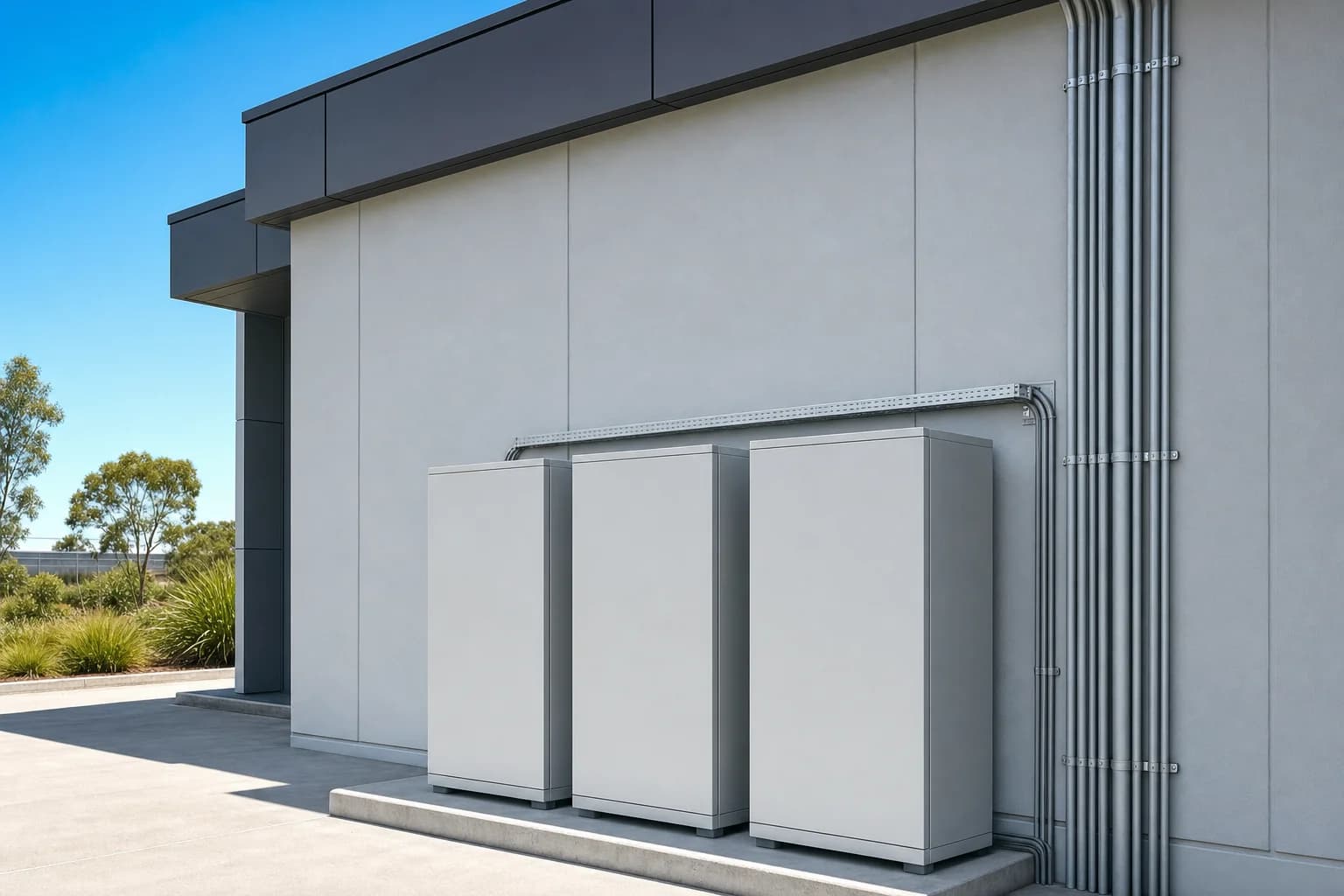
- The battery inverter, not just the cells, often sets the real kW limit
Your load profile decides this, not your bill total
A quarterly bill tells you how much energy you bought. It says almost nothing about when you bought it, and when is the entire question for storage.
Two Gold Coast businesses can spend the same each quarter and need completely different batteries. One shuts the doors at four and uses nearly everything while the sun is up. The other runs cold rooms all night.
The first has very little for a battery to do. The second has a load that keeps running long after generation stops, and that is what sets the kWh.
- When your usage actually starts and finishes on a normal weekday
- Whether anything meaningful runs overnight
- What happens on weekends and over shutdown periods
- Whether your peak is a steady plateau or a short spike
- How much solar you are currently exporting instead of using
Storing surplus solar and shaving peak demand are different jobs
A commercial battery is usually bought for one of two reasons, and the two pull the sizing in different directions.
Storing surplus solar is an energy job. You are moving daytime generation into the evening, so the question is how many kWh you genuinely have spare and how many you can use later.
Shaving peak demand is a power job. You are covering a short spike so the grid never records it, which can call for serious kW and surprisingly little kWh.
Plenty of sites want both. Then you size for whichever constraint is harder and check the other still holds, which is a modelling exercise rather than a rule of thumb.
Interval data beats every rule of thumb
Your meter records consumption in intervals through the day, not just as a quarterly total. That data is what turns battery sizing from a guess into arithmetic.
With it, we can see your real overnight load, the shape and length of your peaks, and how much solar you are exporting rather than using. Without it, anyone sizing a battery for you is inferring all three.
Ask your electricity retailer for it, ideally a full 12 months, so it captures summer cooling as well as your quieter periods. Flag any stretch that was not typical, such as a shutdown.
It is the most useful thing you can do before you collect quotes. The same data also decides how many panels your business needs on the roof.
What changes the answer a year or two from now
The load profile you size against is a snapshot. Businesses grow, and the changes that matter most for storage are the ones that add load after dark or add sharp spikes.
Refrigeration, a second shift, a large compressor, longer trading hours, taking on a neighbouring tenancy. Each of those moves the numbers, and anything with a heavy start-up draw moves the kW rather than the kWh.
Workplace or fleet EV charging moves them more than most, because a charger is a large load that can also be shifted in time. We set that out on our commercial EV charging page.
If any of it is on the horizon, say so early. It is far cheaper to leave room for expansion in the original design than to rework switchgear afterwards.
Why we will not name a size in this article
You will find articles that hand you a number, usually as a fraction of your solar system or a multiple of your daily use. We are not going to, because a size derived from a bill total is a guess dressed up as advice.
A battery sized too small never covers the load you bought it for. One sized too large does not fail, it simply sits half-cycled with your capital inside it. Neither problem shows up until it is installed and running.
So here is the honest position. We size storage against your interval data and your tariff, we show you the assumptions we used, and if the shape of your load does not justify a battery yet we will tell you that instead.
More detail on how we specify storage sits on our commercial solar batteries page. Before you sign anything, these are the questions that make two battery quotes genuinely comparable.
- What kW and what kWh is this system, and which of the two did you size first?
- What load profile did you size it against, and where did that data come from?
- Is this sized for evening self-consumption, for peak demand, or for both?
- What happens to the sizing if we add equipment or extend our hours?
- Can this system be expanded later, and what would that involve?
Frequently asked questions
What size battery does my business need?+
There is no size we can name without seeing your interval data. Sizing comes from when you use power, not how much you spend, so two businesses with identical bills often need different systems. Get 12 months of meter data from your retailer first, then the sizing becomes arithmetic.
What is the difference between kW and kWh on a battery?+
kW is power, meaning how fast the battery can deliver or absorb energy at any moment. kWh is capacity, meaning how much energy it holds in total. Both are quoted on every commercial battery, and confusing the two is the most common mistake we see when businesses compare systems.
How do I get interval data for my site?+
Ask your electricity retailer for your interval or smart meter data, ideally covering 12 months. It arrives as a file showing consumption through each day rather than one quarterly total. A full year matters because it captures summer cooling loads as well as your quieter periods.
Is a bigger battery always better?+
No. An oversized battery does not break anything, it just sits partly used with your capital tied up in it. Storage only earns its keep when it cycles regularly, so the aim is to match the load it will genuinely serve rather than buy the largest unit on offer.
Can I start with a smaller battery and add more later?+
Often yes, but it depends on how the system is designed at the start. Expandability comes down to the inverter, the switchboard, and the physical space and ventilation set aside for it. If growth is likely, tell us early so the first install leaves room for it.
Does my battery need to match my solar system size?+
No, the two are sized for different things. Solar is sized against your roof and your daytime generation potential, while a battery is sized against your evening load or your demand peaks. A site with a large array can still need only modest storage if most power is used in daylight.