AI overview
Commercial battery storage is worth it when a site has high evening usage, steep peak-demand charges, or a need for backup power. Batteries earn their return through self-consumption, peak shaving and resilience, but the payback depends heavily on your tariff and load profile.
Key highlights
- Batteries pay back fastest on high evening-use sites
- Peak-demand shaving can cut a hidden part of your bill
- Backup keeps refrigeration, EFTPOS and security running
- Safe LFP chemistry is the commercial standard
- Sizing matters, an over-sized battery sits idle and wastes capital
- The numbers depend on your tariff, so model before you buy
Summarise with AI
Open this article in your favourite AI assistant for a quick summary and a local recommendation.
Storage is the most over- and under-sold part of commercial solar. The truth is it depends entirely on your site.
On some businesses a battery transforms the return on solar. On others it sits half-used and never pays for itself.
Here are the three jobs a battery does, and how to tell whether they add up for your business.
Self-consumption after dark
A battery stores the solar you would otherwise export for cents and lets you use it in the evening at full retail value.
That is valuable for businesses that keep trading or running equipment after the sun goes down.
If your power use drops off the moment the sun sets, a battery has far less work to do, and the case for it weakens.
Shaving peak-demand charges
Many commercial tariffs charge based on your highest demand spike in a period, not just total usage.
A short, sharp spike can lift your bill for the whole month, even if your overall consumption is modest.
A battery can discharge to cover those spikes so the grid never sees them, cutting a part of the bill many businesses do not even realise they are paying.
Backup and resilience
With the right configuration, a battery keeps critical circuits running through a grid outage.
For cold storage, hospitality or anyone reliant on EFTPOS and security, that resilience can be worth more than the energy savings.
It is worth deciding up front which circuits must stay live, because that shapes the size and wiring of the system.
When a battery probably is not worth it
Storage is not a default add-on, and on plenty of sites the honest answer is to skip it for now.
If your usage matches your solar production closely through the day, you may already be self-consuming most of what you make.
In that case the money is often better spent on more panels than on a battery that rarely cycles.
- Most of your power is used during daylight hours
- Your tariff has no meaningful peak-demand charge
- You have no critical loads that need backup
- Your roof still has room for cheaper extra panels
Why chemistry and safety matter
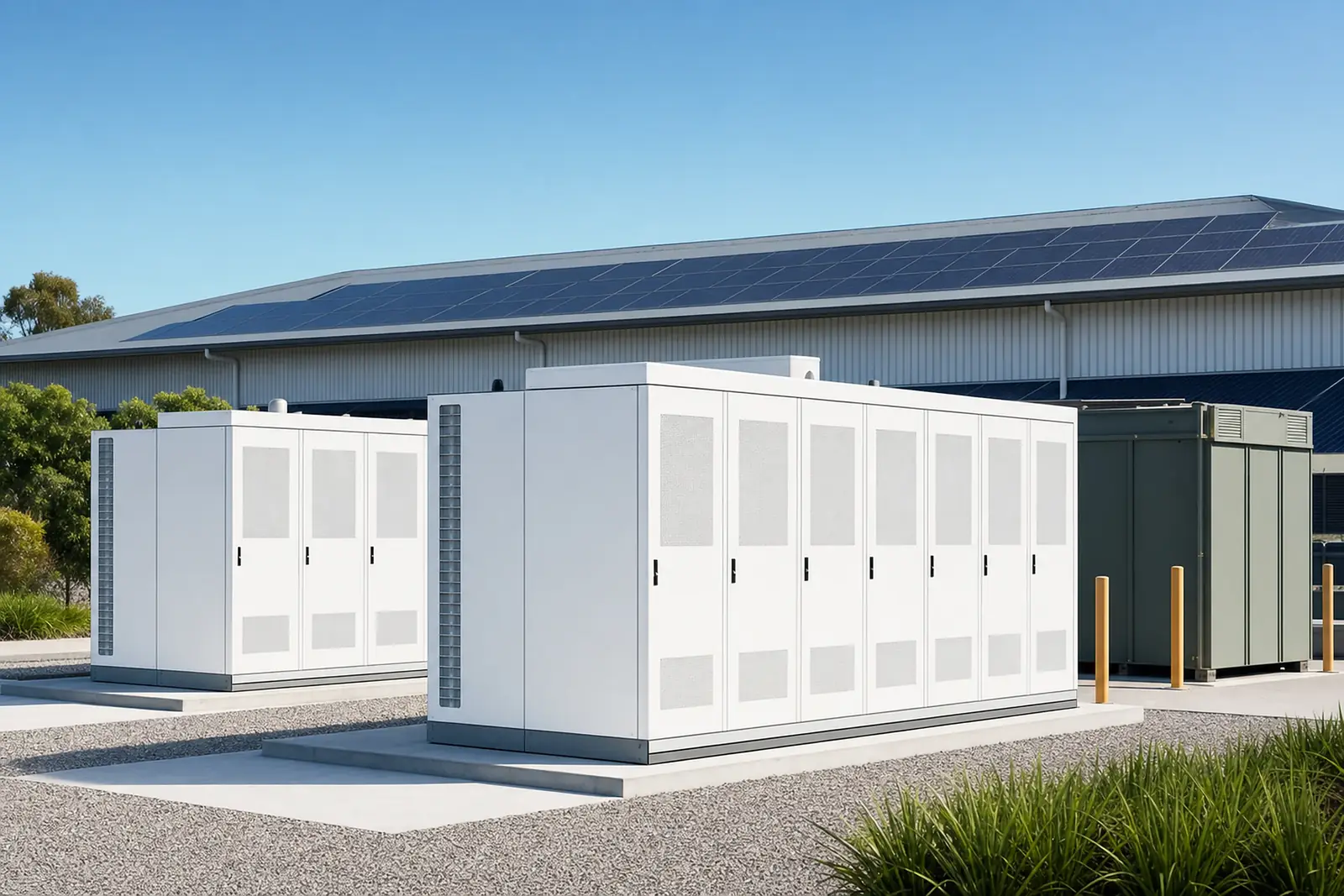
Commercial storage is a long-term, high-value asset sitting on your premises, so safety is not the place to cut corners.
Lithium-iron-phosphate, or LFP, is the commercial standard because of its long cycle life and strong thermal stability.
We specify LFP systems with proper protection and monitoring so the battery is safe to run unattended for years.
- LFP chemistry for cycle life and thermal stability
- Battery management and monitoring built in
- Correct ventilation and clearances on install
- A warranty that covers cycles, not just years
Model the numbers before you buy
The only way to know whether a battery pays for itself is to run it against your real tariff and load profile.
We model storage on your actual data, so the recommendation reflects your site rather than a sales pitch.
If the numbers do not stack up, we will tell you to hold off, because a battery you do not need is just expensive shelf space.
Can you add a battery to existing solar?
Plenty of businesses install solar first, then add storage once they understand their usage pattern.
Whether a retrofit is simple depends on your existing inverter and how the system was wired.
If you think a battery is on the cards down the track, it is worth designing the original solar to make adding one later straightforward.
- A hybrid inverter makes adding storage simpler later
- AC-coupled batteries can pair with most existing systems
- Space and ventilation need to be planned for the unit
- Critical circuits can be set up for backup at install time
Frequently asked questions
Will a battery pay for itself?+
On the right site, yes. Sites with high evening use, steep demand charges or a need for backup see the strongest returns. We model your tariff and load before recommending storage.
What battery chemistry is best for business?+
Lithium-iron-phosphate (LFP) is the commercial standard thanks to its long cycle life, thermal stability and strong safety record.
How big a battery do I need?+
It depends on how much evening usage and peak demand you want it to cover. Over-sizing wastes capital, so we size it to the load it will actually serve rather than the biggest unit available.
Can a battery keep my business running in a blackout?+
With the right setup, yes. We can wire critical circuits like refrigeration, EFTPOS and security to stay live through an outage. Decide up front which loads must stay on.
Is a battery safe to install on my premises?+
Quality LFP systems are designed for unattended commercial use, with built-in management, monitoring and proper install clearances. Safe operation comes down to good chemistry and a correct install.
Should I add a battery now or later?+
Many businesses install solar first and add storage once they see their usage pattern, or once their evening load or demand charges justify it. The wiring can be designed to make adding a battery later straightforward.