AI overview
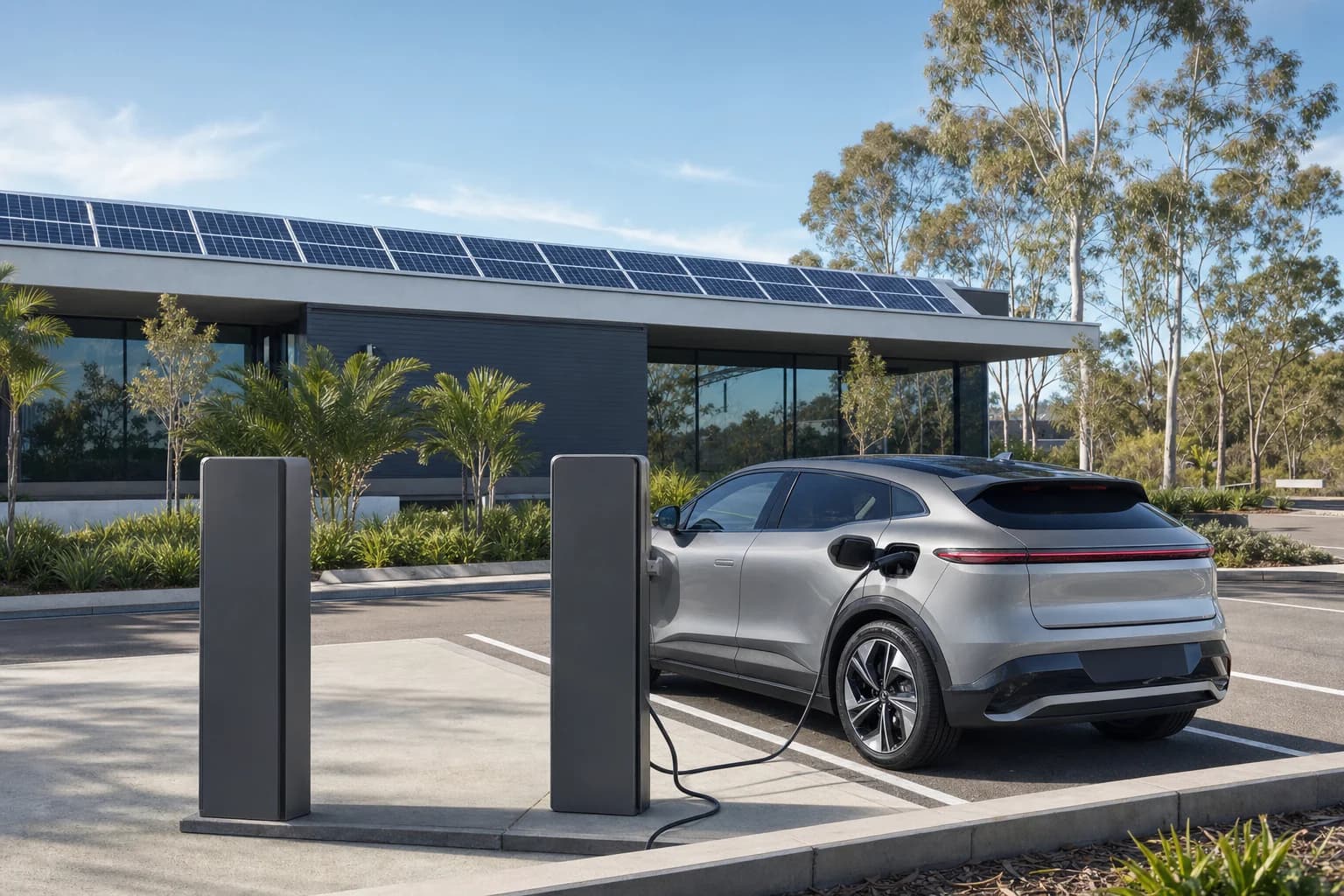
Commercial EV charging comes in two forms: AC chargers, which are limited by the speed of the vehicle's onboard charger, and DC chargers, which convert power inside the unit and charge far faster. The right choice is decided by how long the vehicle is parked, not by the biggest number on the spec sheet. On most sites the real constraint is the electrical supply at your switchboard, and for a business with solar, daytime charging lines up closely with daytime generation.
Key highlights
- AC or DC is decided by dwell time, meaning how long the vehicle sits there, not how fast the charger can go
- Workplace, fleet and customer charging are three different jobs with three different specifications
- The charger is rarely the constraint. Your switchboard and incoming supply usually are
- Nobody can price a commercial EV charging install honestly without looking at your board
- Vehicles charging through the middle of the day are the closest natural match for rooftop solar
- Load management lets several chargers share the supply you already have instead of upgrading it
Summarise with AI
Open this article in your favourite AI assistant for a quick summary and a local recommendation.
Most Gold Coast businesses we talk to about chargers did not go looking for them. A couple of vehicles in the fleet turned electric, or a staff member asked, and suddenly there is a question about the car park.
It is a smaller decision than solar and it goes wrong more often. Nearly all of the trouble comes from picking hardware before anyone has looked at what the site can actually supply.
This is a useful thing for us to be involved in, because we are already standing at your switchboard looking at your roof. Here is how the choice really works.
AC and DC: what actually separates commercial electric vehicle chargers
Every electric vehicle stores DC power in its battery, and the grid delivers AC. Something has to convert one into the other. The only real question is whether that happens inside the car or inside the charger.
An AC charger passes AC to the vehicle and lets the car's onboard charger do the conversion. That means the car sets the ceiling, not the wall unit. A larger AC charger will not make a vehicle with a modest onboard charger any faster.
A DC charger does the conversion itself and feeds the battery directly, which is why it is quicker. It is also physically bigger, considerably more expensive, and much hungrier for supply.
Neither one is better. They answer different questions, and the question is always how long the vehicle is standing still.
- AC: cheaper, smaller, simpler to install, speed capped by the vehicle's onboard charger
- DC: faster, larger, more expensive, and it needs far more supply at the site
- kW is the rate power flows. kWh is the energy delivered. Time parked is what turns one into the other
- Hours of dwell time and AC is usually plenty. Minutes of dwell time and only DC will do
The three jobs a commercial EV charger has to do
Workplace charging, fleet charging and customer charging get sold as one product. They are not one product. They have different users, different dwell times and different ways of failing.
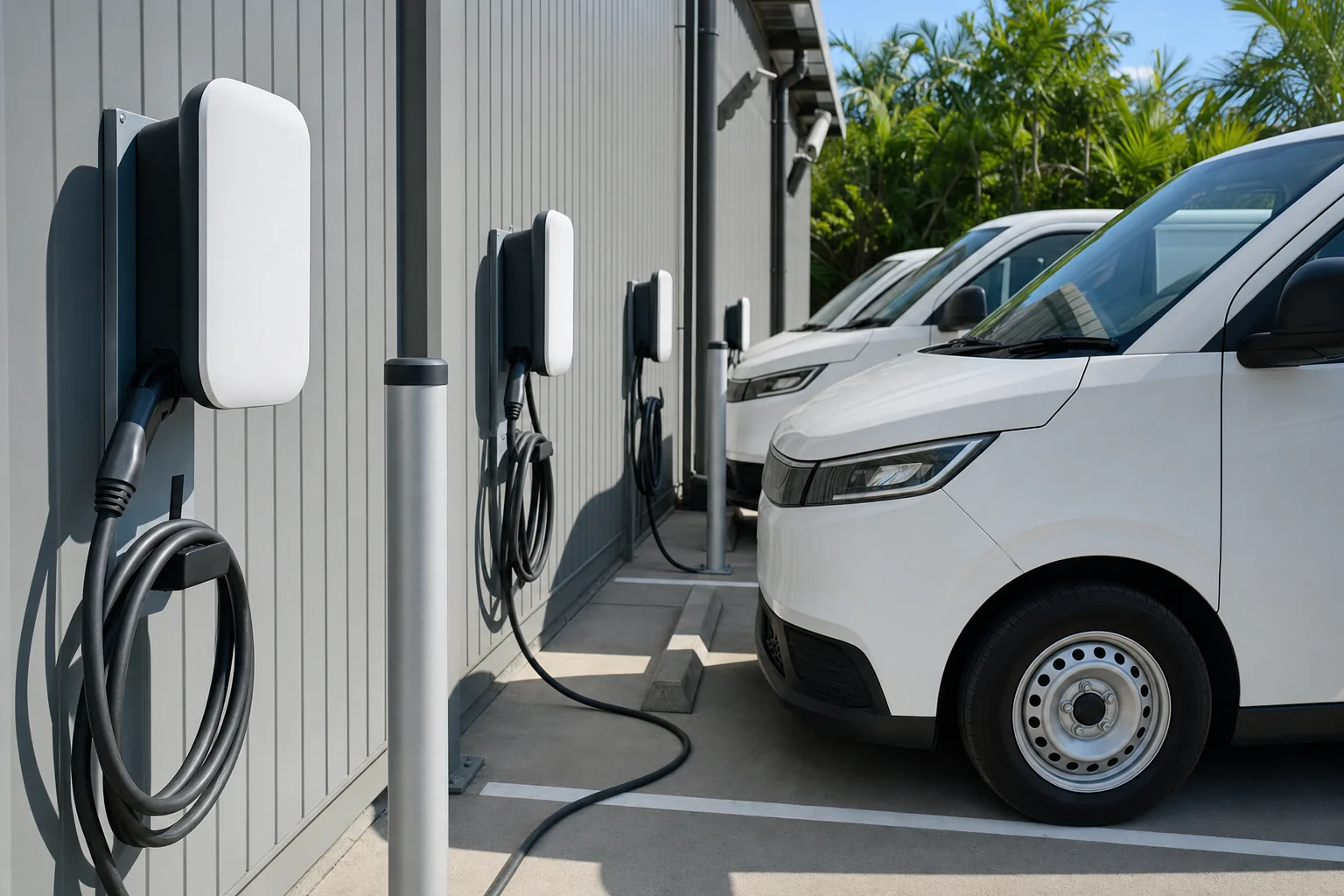
Staff parking is the gentlest case. Cars arrive in the morning and leave in the afternoon, so the window is long and AC covers it comfortably. The interesting design problem is sharing supply across many bays, not speed.
Fleet charging is an operations problem before it is an electrical one. What matters is whether a vehicle has to be ready between shifts or only by the next morning. That one fact decides AC or DC on its own.
Customer and visitor charging is different again. Someone topping up while they shop or eat wants visible progress in a short stay, which pushes towards faster hardware in a small number of bays, plus a way of handling who pays.
- Workplace: long dwell, many bays, AC, load sharing matters more than raw speed
- Fleet: dwell time is set by your roster, so map the shift pattern before choosing hardware
- Customer or visitor: short dwell, fewer bays, faster charging, and a payment plan you have thought about
- Running all three on one site is normal. They should still be specified separately
Why your switchboard decides what a commercial EV charging station costs
This is the part that catches people out. Choosing a charger takes an afternoon. Working out whether your site can feed it is the actual project.
Chargers draw hard, and unlike lighting they can draw hard for hours at a time. What matters is your incoming supply, your main switch rating, and how much of that is already spoken for by everything else running on site.
Whether you are on single-phase or three-phase, how far the cable has to run from the board to the car park, and how much headroom you have at your busiest hour will all move the price more than the unit on the wall does.
There is often a way around an upgrade. Load management shares a fixed amount of supply across several chargers, throttling them when the site is busy rather than tripping anything over.
It is also why nobody can price this over the phone. A quote for a commercial EV charger given without seeing your board is a guess, and guesses are always cheap until the electrician arrives.
Charging off the power your roof already makes
Here is why this belongs next to a solar conversation. A solar system generates through the middle of the day, and most workplace charging happens through the middle of the day. That overlap is the whole opportunity.
The economics fit in one sentence. Power you generate and use on site avoids what you would have paid to buy it, while power you export earns a feed-in credit that is usually lower than the rate you buy at.
So a car park full of vehicles charging at midday quietly converts exported energy into avoided energy. For most businesses that is the best use they will find for a sunny afternoon.
It also changes how the system should be sized. If chargers are coming, they belong in the load profile from the beginning rather than being bolted on later. Our guide to how many panels your business needs walks through how that calculation is done.
Batteries, schedules and vehicles that come home after dark
That neat overlap disappears the moment your vehicles are out all day and back at night. A fleet that charges after dark is charging on grid power, however many panels are on the roof.
This is where a battery can earn its place. It holds what the roof made during the day so it can be used in the evening, which is the same argument we set out on our commercial solar batteries page.
Whether it stacks up depends on your tariff and how much of your charging is genuinely after hours. That is worth measuring rather than assuming, in either direction.
Scheduling is the cheaper lever and it gets skipped constantly. Most commercial chargers can be told when to run, so any vehicle that only needs to be full by morning can be pushed into the solar window or away from your peak period.
Demand charges are worth understanding before you add chargers. On many commercial tariffs part of the bill is set by your highest demand, so several chargers all starting at once can cost you in a way the energy alone does not explain.
What we will not tell you, and what to ask before you sign
We will not tell you what your install will cost, or how fast your vehicles will charge, from an article. Both depend on your supply, your cable run and the cars themselves. Any figure written here would be a guess wearing the costume of a fact.
We also will not tell you that chargers pay for themselves. Sometimes the case is clean, and sometimes the honest answer is that it is a staff benefit or a reason for customers to stop. That is a perfectly good reason to do it, as long as you decide it with your eyes open.
What you should expect from anyone quoting the work is that they physically looked at your board, and that they can separate the price of the charger from the price of the electrical work needed to feed it.
How we scope and install this is set out on our commercial EV charging page. The questions below matter more than the brand on the unit, and they work just as well on somebody else's quote.
- What is the spare capacity at my main switchboard, and did you measure it or estimate it?
- Is this AC or DC, and what dwell time did you assume when you chose?
- How much of this price is the charger, and how much is cabling, switchboard work and civils?
- Does the design support load management so I can add bays later without upgrading supply?
- Can the chargers be scheduled to run in daylight, and who sets that up?
- If I want to bill staff or the public, how is that handled and what does it cost to run?
- Will this work with the solar we have or are planning, and who owns the problem if it does not?
Frequently asked questions
What is the difference between an AC and a DC commercial EV charger?+
An AC charger sends AC power to the vehicle and lets the car's onboard charger convert it, so the vehicle sets the speed limit. A DC charger does the conversion inside the unit and feeds the battery directly, which is much faster but needs far more electrical supply at the site.
Which type of charger suits a workplace car park?+
Usually AC. Staff vehicles sit still for most of the working day, so there is ample time to add range without fast hardware. Spending the budget on more AC bays with load sharing normally serves far more people than one fast charger that can only ever charge a single car.
Can I run EV chargers from my existing solar system?+
Often yes, provided the charging happens in daylight and your system has generation to spare at that time of day. It depends on your current load profile and system size. If chargers are part of the plan, they belong in the sizing calculation before the system is designed.
Do I need a battery to charge vehicles from solar?+
Only if the charging happens outside daylight hours. Vehicles parked on site through the day can draw straight from the roof. A battery matters when your fleet returns in the evening, because it stores daytime generation for use after dark instead of buying that power back from the grid.
Why can you not quote a commercial EV charging station over the phone?+
Because the charger is rarely the expensive part. The cost sits in your switchboard capacity, the cable run out to the car park, and whether your incoming supply needs upgrading. None of that can be assessed remotely, so a phone quote is a number with nothing behind it.
How many charging bays should we install?+
Start with how many vehicles need charging on the same day and how long each one is parked. It is usually cheaper to run cabling for more bays than you need now and add units later. Ask whether the design allows that before you commit to the first stage.