AI overview
The best commercial solar panels for Australian conditions are Tier-1, CEC-approved modules with high efficiency, a low temperature coefficient for heat tolerance, and a strong 25-year performance warranty. The best panel for your site depends on your roof space and budget, not just the brand.
Key highlights
- Look for Tier-1, CEC-approved modules with a field track record
- High efficiency matters most when roof space is tight
- A low temperature coefficient keeps output up in Queensland heat
- Expect a performance warranty of around 25 years
- Local support matters as much as the brand on the box
- The best panel is the one matched to your roof and budget
Summarise with AI
Open this article in your favourite AI assistant for a quick summary and a local recommendation.
There is no single best panel, only the best panel for your roof, your budget and your conditions.
Brand loyalty is easy, but it is the spec sheet and the support behind it that decide how a panel performs in twenty years of Queensland sun.
Instead of chasing names, here are the qualities that actually matter for a commercial system.
Tier-1 and CEC-approved
Tier-1 is a financial-bankability ranking, not a quality grade, but in practice it is a useful proxy.
It points to manufacturers with a proven track record and the financial backing to honour a warranty in two decades.
CEC approval means the panel is approved for use and rebates in Australia, and we only specify panels that meet both.
Why efficiency matters most on a tight roof
Efficiency is how much of the sunlight hitting a panel becomes usable power.
Higher efficiency means more power per square metre, which counts most when roof space is limited.
If you have plenty of roof, a slightly less efficient panel can be the smarter value play, since you can simply fit more of them.
- Tight roof: pay up for efficiency to fit more power in less space
- Large roof: a mid-tier panel can match the output for less
- Shaded sections: efficiency helps you make the most of clear areas
- Future expansion: leave room rather than maxing the roof out now
Heat tolerance and the temperature coefficient
Panels lose output as they heat up, and on a Gold Coast roof in summer they get very hot.
The temperature coefficient measures how much output drops per degree of heat, so a lower number is better.
In our climate, heat tolerance can matter more than headline efficiency, because it protects output through the hottest, sunniest months.
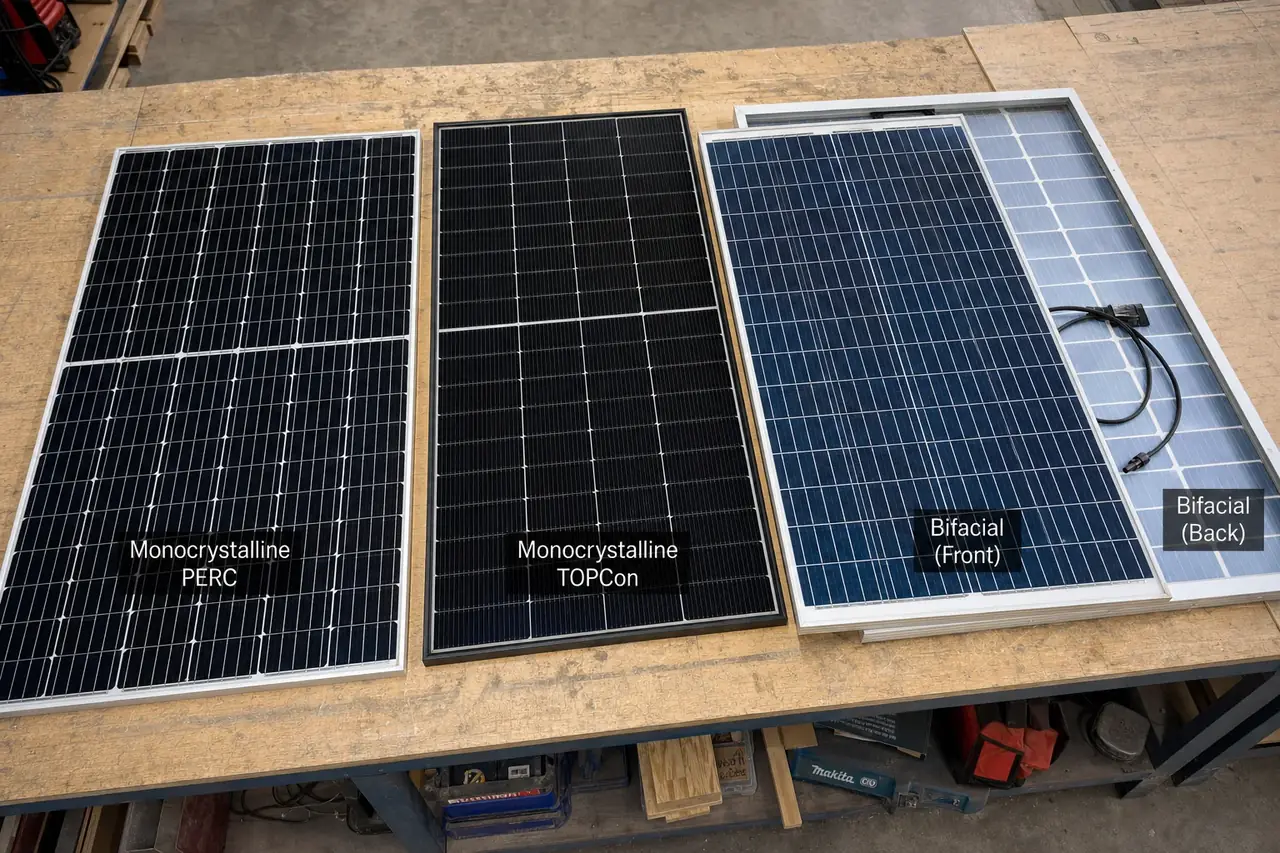
Warranty that actually means something
Quality commercial panels carry performance warranties of around 25 years and product warranties on the hardware itself.
A warranty is only as good as the company standing behind it, which is where Tier-1 status and local support come in.
A long warranty from a manufacturer that may not exist in a decade is worth far less than it looks on paper.
What to look for on the spec sheet
When you compare panels, a few numbers tell you most of what you need to know.
Run your eye down these and you can cut through the marketing quickly.
- Tier-1 status and current CEC approval
- Rated efficiency as a percentage
- Temperature coefficient, lower is better
- Product warranty on the hardware
- Performance warranty and the year-25 output guarantee
- Australian support and a local presence
Don't overlook the inverter
Panels get all the attention, but the inverter is the part that does the daily heavy lifting and is the most likely to need attention over time.
A premium panel paired with a cheap inverter is a false economy.
We match the inverter to the panels and the site so the whole system performs and lasts, not just the part on the roof.
- Match the inverter capacity to the array size
- Choose string or three-phase to suit the site
- Check the inverter warranty alongside the panel warranty
- Confirm local support and parts availability
Common mistakes when choosing panels
Most panel regrets trace back to a few avoidable decisions made at quote time.
Knowing them up front helps you ask the right questions before you commit.
- Buying on brand name alone, without reading the spec sheet
- Ignoring the temperature coefficient in a hot climate
- Choosing a long warranty from an unstable manufacturer
- Pairing premium panels with a bargain inverter
- Maxing out efficiency on a roof that has space to spare
Frequently asked questions
Are expensive panels always better?+
Not always. The best value comes from matching the right panel to your roof and budget. Sometimes a mid-tier panel in the right size outperforms a premium one that does not suit the site.
What is a temperature coefficient?+
It measures how much a panel's output drops as it heats up. A lower coefficient means the panel holds its output better in the heat, which is valuable in Queensland.
Does Tier-1 mean the panel is high quality?+
Tier-1 is a financial-bankability ranking rather than a quality grade, but it is a strong signal of a stable manufacturer likely to honour its warranty. We pair it with field performance when we specify panels.
How long should a commercial panel last?+
Quality panels carry performance warranties of around 25 years and often keep producing well beyond that, at a gradually reduced output. The inverter typically needs attention sooner than the panels.
Should I pick the most efficient panel available?+
Only if roof space is tight. With a large roof, a slightly less efficient panel can deliver the same output for less by simply fitting more modules. We size the choice to your roof.
Does the inverter brand matter as much as the panels?+
It matters a great deal. The inverter works hardest and is the most common part to need service, so we match it carefully to the panels and the site.